
JOIN US FOR A VIRTUAL MEETING!
TUESDAY, May 20TH, 2025 at 7:15 p.m. via ZOOM
Click here to view the recording from the May 2025 Meeting.
Passcode: Cd4fwT?P
SPEAKERS:
Maryland Senator Brian Feldman
District 15 Delegates: Lily Qi, Linda Foley, and David Fraser-Hidalgo
Each year our District 15 Delegation briefs us on the completed legislative session. This legislative session focused on energy resources, protecting immigrant communities, and ensuring a balanced budget. The 2025 Maryland General Assembly passed bills to support clean energy, protect women and families, and respond to recent federal actions, along with securing more direct funding for projects in District 15, including several school playgrounds and two Arts Centers. We look forward to hearing a detailed briefing on the session.

As always, the public is welcome to attend!
WE’VE LOST OUR NORTH STAR
A Champion in Preserving the Potomac Sub-region, our Environment, and Justice
President’s Letter by Ginny Barnes
We are still shocked and saddened by the recent death of longtime Board member Susanne Lee who gave so much to the Potomac Community through her more than 25 years of commitment to WMCCA and the environment she loved here in our Sub-region. She took on the responsibility of WMCCA President many times. She developed expertise in sewer policy and zoning issues. Her years as a lawyer for the EPA served WMCCA well in any issue before the Planning Board, Hearing Examiner, or in court with judges. We relied on her knowledge, her integrity, and our certainty of what she knew. Susanne was thorough in her research, worked consistently with our lawyers Norman Knopf and Dave Brown, and guided neighbors in seeking legal counsel for threats to their immediate communities. Everyone who worked with her feels her absence. This is especially true of our Board of Directors for whom she was a constant.

In 2018, I nominated her for the Citizen of the Year Award in part because of her extreme modesty. She deserved much honor for her tireless work and this was a way to give her a bit of a shout out she could not rebuff. The Chamber of Commerce voted to make her the recipient and that settled it. Out of my hands. But at the awards dinner it was clear she was pleased as she filled nearly 2 tables with invited family and friends. She enjoyed the gathering and was her usual gracious self in accepting the award. I tried not to overwhelm her in the speech presenting it, but she still played down her accomplishments. Anyone could see she had fun riding in a convertible in the Potomac Day parade.
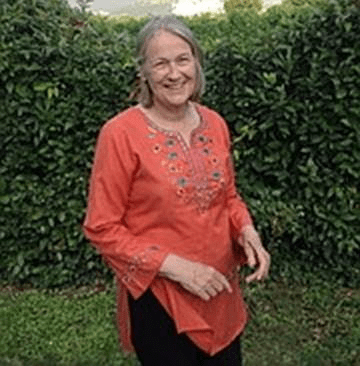
There is so much more to say about her commitment to the environment. She loved the water; wetlands, streams, rivers, and the sea. She understood and defended forests and trees for their role in water quality protection. For years she served on two water quality monitoring teams in the Audubon Naturalist Society (now Nature Forward) in the citizen water quality monitoring program created in the 1990’s. One of those teams was on the Piney Branch, a tributary of Watts Branch, and we had worked together to uphold parts of that beleaguered stream as a Special Protection Area due to environmental sensitivity, particularly in the headwaters. She lived in those headwaters and could see first-hand how impacts of land use there affected the entire watershed. She loved birds and the ephemeral flowers we see each Spring.
How we carry on without her is hard to imagine. WMCCA sorely needs the zoning and legal skills that she brought in abundance. We only know that she would want us to carry on doing the work of the well-respected citizens association we’ve always been. On behalf of the entire membership we bid her a sad yet fond farewell.
Trees on South Glen Road
Submitted by Ginny Barnes
At our April 8th General meeting we had speakers from the Montgomery County Department of Transportation and inquired about the destruction of several large trees at the sharp curve on South Glen Road. South Glen is a Rustic Road and entitled to extra scrutiny in maintenance concerns. Mr. Nesselt, Section Chief of Tree Maintenance, looked into this and found the cutting was initiated by Pepco. They asked a Montgomery County arborist to inspect two White Oaks. It was determined one tree was dead, the other had a dead top. Pruning the tree to ensure reliability of utility and safety of the road would have made poor cuts, the tree would not be able to compartmentalize thus making the tree more prone to decay and becoming a greater hazard in the future. The Maryland Department of Natural Resources also inspected the tree and independently verified the finding before issuing the final Roadside Tree Permit. Pepco was responsible for cutting down the trees down on South Glen Road.
Updated Regional Maps
Submitted by Nancy Madden
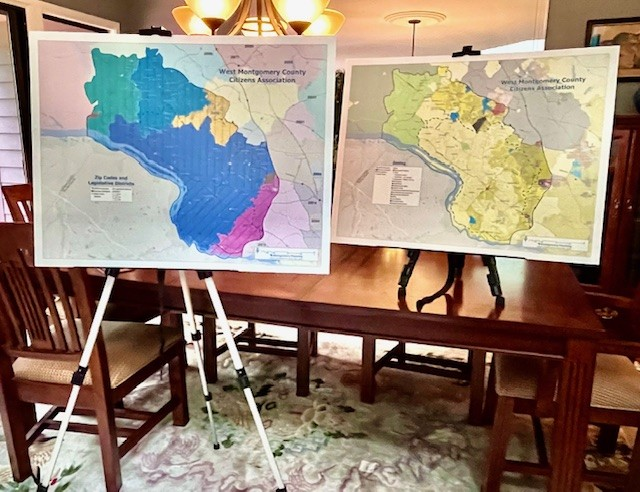
Board Member Barbara Hoover has updated the regional maps WMCCA uses to show members and those new to the Potomac community crucial information about their homes, neighborhoods, and the sub-region WMCCA represents and works to protect. These new maps now show zoning, watersheds, parklands, sewer, and legislative districts – all in beautiful color and amazing detail! We will have these maps posted on our website, with printed posters displayed at our General Meetings as well as in our booth at the annual Potomac Day in October. The maps posted on our website will give the viewer the ability to enlarge sections and give them crucial information about their neighborhood as well as their individual street.
2025 ELECTION OF WMCCA OFFICERS AND BOARD of DIRECTORS
The election of the WMCCA Officers and Board of Directors will occur at our May 20th General Meeting. The Nominating Committee proposes the following slate of Officers and Directors to the membership for a vote. Nominations may also be made from the floor.
President: CAROL VAN DAM FALK
Immediate Past President: GINNY BARNES
President Elect: SHAWN JUSTEMENT
Secretary: KATHY PETITT
Treasurer: BARBARA HOOVER
Newsletter: NANCY MADDEN
Vice President – THEODORA SCARATO
To serve 2nd Year of their two-year term (no action needed): BARBARA BROWN
VIRTUAL ZOOM WMCCA Meeting May 20, 2025 – 7:15 p.m.
West Montgomery County Citizens Association Newsletter
P.O. Box 59335, Potomac, MD 20859
President – Ginny Barnes: President@WMCCA.org
Website: WMCCA.org – Thomas Fahey
Newsletter Editor – Nancy Madden
WMCCA has been protecting the Green Wedge of the Potomac Subregion since 1947
 West Montgomery County Citizens Association