
Next Meeting:
TUESDAY, December 9, 2025 at 7:15 p.m.
IN-PERSON AT THE POTOMAC LIBRARY!
SPEAKER: Diana Conway, President, Safe Healthy Playing Fields, Inc. (SHPFI)

Montgomery County’s promotion and use of synthetic turf fields continues to be a huge environmental and health problem in our area for well over a decade. A group of concerned parents and environmental activists (SHPFI) have been working to educate/inform communities and policy makers with the facts about synthetic turf for over 15 years. We are delighted to have longtime Potomac resident, former WMCCA Board member, and President of the Safe Healthy Playing Fields, Inc. Diana Conway speak at our General Meeting. Diana will provide the latest developments in the fight to install and maintain natural grass playing fields and to steer clear of toxic synthetic turf.
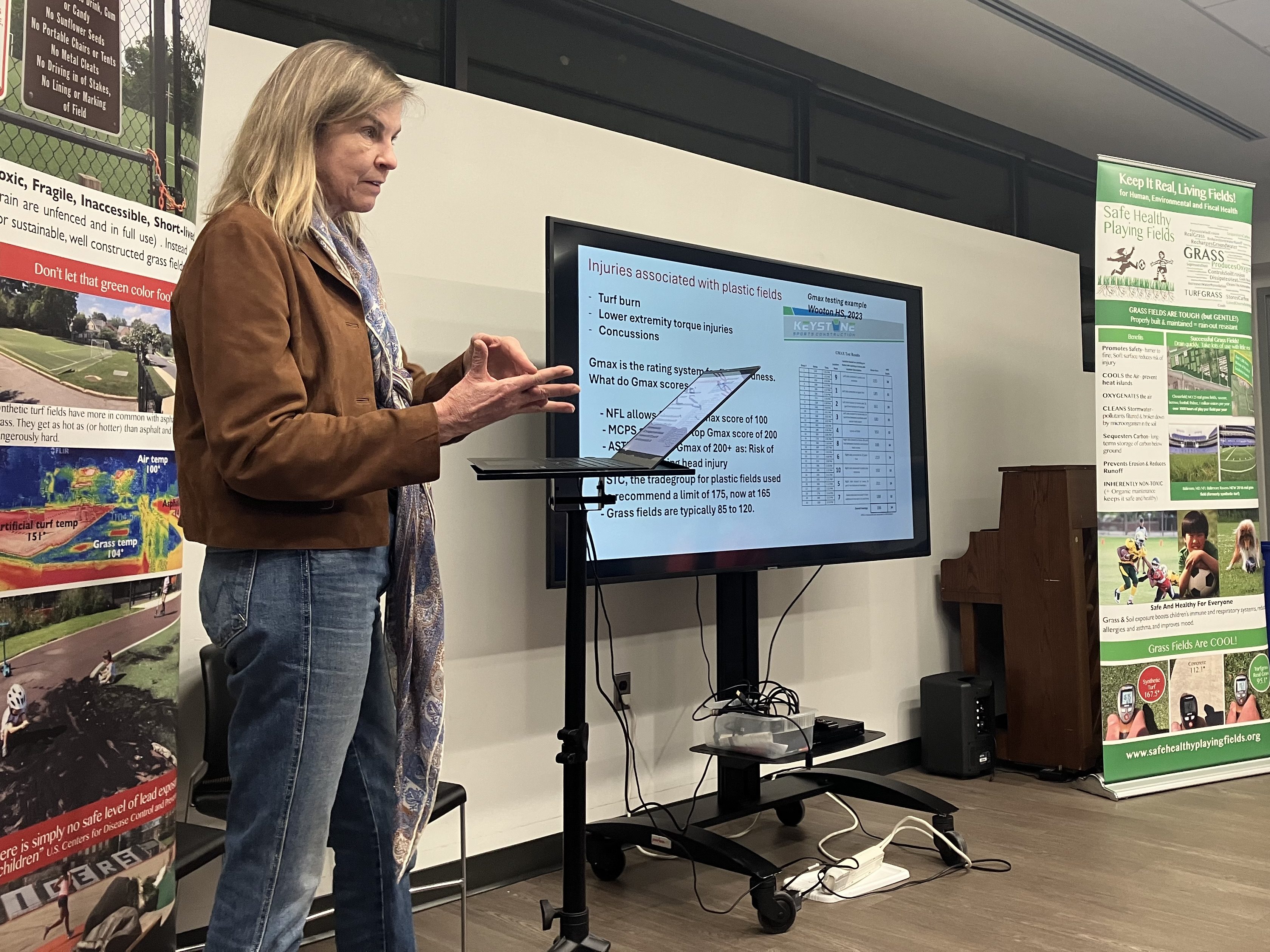
As always, the public is welcome to attend!
Health and Safety Risks of Synthetic Turf
President’s Letter by Carol Van Dam Falk
Montgomery County Public Schools approved the Capital Improvement Program (CIP) and has sent it to County Executive Mark Elrich, which includes all 9 synturf fields for 2027 and more plastic fields until 2032, with no amendments about athletic fields or playgrounds. This is disturbing on many fronts. If this trend cannot be halted, all high school fields and some middle and elementary school fields in the County are slated to turn plastic by 2032.
One Montgomery Green strongly recommends that CIP funds planned for the installation and replacement of artificial turf fields be redirected toward durable, natural turf, with remaining funds applied to other critical school infrastructure needs. Upgrading existing natural fields and installing state-of-the-art grass instead of plastic on new fields is cost-effective and environmentally responsible, especially when climate change is the existential threat of our generation and those to come. Higher costs linked to artificial turf installation, maintenance, repeated replacement and associated disposal costs “create a substantial, on-going financial burden that competes with more urgent school system needs such as HVAC replacements, roof repairs, safety upgrades, and other critical improvements needing limited CIP funds,” says One Montgomery Green.
For those who argue plastic fields are more resilient after heavy rains, modern grass offers improved drainage and durability, which translates into extended playability at much lower life cycle cost than artificial turf. Also, grass can be enhanced over time. Artificial turf, which contains lead – a known carcinogen – and PFAs, cannot.

Synthetic turf is a risk to the health and safety of MCPS students due to:
- The high heat of the surface – hotter than asphalt in the sun.
- Frequent exposure to microplastics and related chemicals.
- Injury risk due to hardness, abrasiveness, and shoes/cleats getting stuck in the carpet which, unlike grass turf, does not give way (so on synturf, ankles and knees twist instead).
Awareness of the environmental and health hazards of microplastics is rising rapidly. The more researchers look, the more they find microplastics everywhere on earth and in human lungs, brains, and even placentas. For more on artificial vs natural turf playing fields, we will hear from Diana Conway, current SHPFI President, a former Potomac Elementary school PTA President and delegate, and longtime environmental advocate in our community.
Don’t miss this meeting!
Federal Action to Fast-Track Cell Towers
Submitted by Theodora Scarato
The FCC is preparing to introduce sweeping new rules in Docket 25-276 that would fast-track the installation of cell towers by preempting many state and local regulations governing tower siting. These actions would limit the authority of Montgomery County in regards to cell tower and wireless facility siting. The proposal is considering capping local fees, tightening shot clocks for application approvals, revising definitions of aesthetics, preempting regulations related to AI, and more. Setbacks, rules that require cell towers to be built a certain distance from homes, schools, and public areas, may be restricted or eliminated if the FCC determines they “materially inhibit” wireless deployment. If a city or locality fails to act within the stricter deadlines, cell tower applications could be automatically approved.
Timeline: FCC NPRM Docket No. 25-276 is scheduled to be published in the Federal Register on 12/1/25. Reply comments will be due 45 days after publication. Comments due: December 31, 2025. Reply comments due: January 15, 2026
T-Mobile Request to Modify Two Potomac Cell Towers
Submitted by Theodora Scarato
T-Mobile has asked to meet with WMCCA to discuss using two existing monopoles to improve wireless coverage in the Potomac area:
- At the Cabin John Volunteer Fire Department on Falls Road the existing pole is currently used only for police and fire communications. T-Mobile is requesting permission to add its commercial antennas to that pole. Apparently, there was a promise not to add commercial cell antennas to that tower when it was first constructed.
- At the Avenel property, the existing tower already hosts AT&T, Verizon, and T-Mobile equipment. T-Mobile is now seeking to extend the pole by 10–13 feet to accommodate its antennas at the top of this extension, stating that the surrounding tulip poplar trees have grown tall enough to block the signal. The land is owned by WSSC, which has indicated it will not approve the pole extension unless the Potomac community supports the proposal.
WMCCA has requested additional information from T-Mobile on the types of antennas and for RFR compliance reports. T-Mobile has requested to present to the community at a WMCCA meeting.
OPaL Cabin John Townhouses Update
Submitted by Carol Van Dam Falk
OPaL Design Building, operated by Cabin John residents Sean Ruppert and Jason Woodard, presented their plan to replace the Level Fitness facility in Cabin John with five townhouses at the corner of MacArthur Blvd. and 77th Street at an October 29, 2025 meeting. About 75 people attended in person and 40 others joined online. The meeting was required for OPaL to file for a commercial-to-residential reconstruction application. In the slightly revised plan from the May 29, 2025 offering, the townhouses will have green roofs on the attached carports. The 32-foot townhouses would be two stories with a cellar and a loft. OPaL says it plans to price the units around $2.5 million a piece. OPaL plans to submit its plan before the end of this year, with the property purchase to be completed by March 2026. The timeline would allow for several months of zoning changes, stormwater management review, and building permit approvals. The first few homes are expected to be built in early 2027. Residents raised concerns over stormwater drainage at the May meeting. OPaL did not directly address those concerns at the October meeting, but stated that it would reduce the impervious land from 65% to 46% and employ some type of bioretention for stormwater.
Board of Ed Gave Students $75,000 to Research Artificial Turf, then Shelved the Report
Submitted by Barbara Hoover
WMCCA has just received this information from the Parents’ Coalition of Montgomery County blog dated November 30, 2025. The Montgomery County Board of Education allocated $75,000to the MCPS-Student Climate Action Council (SCAC) to Research Artificial Turf. After 18 months of intensive research, the Student Climate Action Council has concluded that artificial turf fields pose a risk to the safety of students and the environment. What did the Board of Education do with this Report that they paid for? Absolutely nothing. The Report has never seen the light of day at a Board of Education Business Meeting. To read more about this and see the SCAC Report, please go to the Montgomery County Parents’ Coalition blogspot.

SAVE THE DATES – MARK YOUR CALENDARS !!
January 13, 2026 General Meeting Speaker – Samantha Puckett of the Izaak Walton League of America will discuss the League’s Salt Watch Program and provide details on how road salt dumped from salt trucks can and does harm the environment.
February 10, 2026 General Meeting Speaker – Timothy Whitehouse, Executive Director, Public Employees for Environmental Responsibility (PEER) to address community concerns about known and unknown sources of PFAS in our daily existence, especially regarding our water supply.
March 10, 2026 General Meeting Speaker – Theodora Scarato will discuss the FCC’s changing policies regarding cell tower installations and modifications, as well as the public safety concerns associated with these towers.
The WMCCA Newsletter is published monthly (October-May), and the Board of Directors meet each month (September-June). We welcome any suggestions for upcoming General Meeting topics and ways to further utilize our web site (www.wmcca.org). Check the web site for information on issues we are working on. If you have any issues or concerns in your neighborhood, please contact WMCCA. We appreciate the input from our neighbors.
Thank you for your support!
IN-PERSON WMCCA Meeting December 9, 2025 – 7:15 p.m.
Potomac Library
West Montgomery County Citizens Association Newsletter
P.O. Box 59335, Potomac, MD 20854-9335
President – Carol Van Dam Falk: President@WMCCA.org
Website: WMCCA.org – Thomas Fahey
Newsletter Editor – Nancy Madden
 West Montgomery County Citizens Association