IN-PERSON WMCCA Meeting October 8, 2024 – 7:15 p.m.

SPEAKER: Lisa Govoni, Housing Policy Coordinator, Montgomery County Planning Department, Maryland-National Capital Park and Planning Commission (MNCPPC)
After years of examining alternatives to increase attainable housing, MoCo planners have recommended a set of zoning modifications, called “The Attainable Housing Strategies (AHS)”, that would allow for structures such as duplexes, triplexes, townhouses, small apartment buildings, and other types of Middle housing to be built within previously single-family zoned areas in the County. The Planning Board has approved this proposal 5-0 on June 13, 2024 and has transmitted them to the County Council. The final Planning Board report can be read online: https://montgomeryplanning.org/wp-content/uploads/2024/06/2024-AHS-Final-Report.pdf . Of greatest concern is that the plan will allow developers to replace homes with multi-family structures “by-right,” i.e., without any public or community participation, and potentially without any appreciable increase in attainable housing. Ms. Govoni will brief us on the report and implications to the Potomac Subregion.
Where’s the Process?
by Ginny Barnes
A bit more than 20 years ago, The Potomac Subregion Master Plan was revised. The process started with appointing a citizen advisory committee and a Planning staff member as liaison. I was on that committee as were quite a few other residents and business leaders. MNCPPC tapped Callum Murray to be our able guide through what became a three-year process. We met monthly. The meetings were open to the public. We reflected the diversity of our community. We elected a Chair. We discussed the issues facing every community Master Plan: infrastructure, sewer and water, schools, senior housing, our rustic roads, storm water. But our overarching theme was the environment. The whole western boundary of our subregion is the Potomac River. We are stewards of that river. It is the major source of drinking water for 3 jurisdictions. As such, virtually every stream watershed in the subregion flows into the Potomac River and ultimately into the Chesapeake Bay. We needed to take a wider view.
Throughout the process, we explored individual and collective future proposals for commercial and private development. We wrestled with the issue of a quarry in our midst, the merits of septic over sewer as a tool for affecting the scale of growth and recognizing our role as a ‘Green Wedge’ low density residential area that abuts and buffers the Agricultural Reserve. We emphasized the value of forests and parkland which preserve and protect numerous wetlands and watersheds so critical to our task.
The merits of the process we used taught valuable lessons. A strong emphasis on citizen buy-in leads to consensus. There is wisdom in allowing for lengthy considerations. And debates. Returning to issues as they emerge in new contexts makes for a conclusion more likely to be thorough. Ours was one of the last of the citizen advisory groups appointed to create an area master plan revision. Subsequently, the process slimmed down to invitations for a series of public meetings to gather ideas. Not nearly as focused on actual possibilities. These avoided the learning process that comes with a group gathering history as they proceed. The final product has served and guided us pretty well over the intervening years.
There have been unexpected challenges. Many from the decision makers themselves. When large development projects requiring certain conditions such as transit and moderate priced housing came up for approval, adherence was waived. Housing offered was not affordable. Access to transit ignored. The result: what is now seen as a ‘housing crisis’. If we are to solve it, Arlington County has shown how not to do it. The recent court ruling (https://www.arlnow.com/2024/09/27/breaking-judge-overturns-missing-middle-zoning-changes/ ) cites a flawed procedure and failure to address basic issues such as sewer capacity and tree canopy laws. Yes, our county needs housing for those who work here. But all citizens deserve a process that is well thought out and honors existing residents and their reliance on a long-held zoning structure. Without it, citizens will fight back.nd rules that can be used and applied to protect our neighborhoods and natural resources.
Equestrian Facility/Barn at Avenel Update
submitted by Kathy Petitt
WSSC recently posted two RFI’s (Request for Information) in regards to the Equestrian Facility/Barn. One for Facility Management and a second for Rehabilitation and Rebuilding Services. The submission deadline was Friday, September 20, 2024. The Avenel Association and Potomac Region Preservation Committee will follow up with WSSC to see if they plan to share any RFI’s that were received and WSSC’s plans and next steps. The Avenel Association has had a second independent structural assessment of the barn completed and that report may be viewed at www.potomacpreservation.com. This Equestrian Facility/Barn has always been a public facility and the intention of requesting the renovation and new management is to provide the community with a local riding and horse boarding facility, especially now that the Potomac Horse Center has been closed (effective July 22, 2024).
New DCA Approach Guidelines
submitted by Carol Van Dam Falk

There’s a bit of good news on efforts to change the flight paths of airplanes enroute to Reagan National Airport that for years have been flying directly over some Cabin John and Potomac neighborhoods, causing extreme noise pollution. Beginning in mid-July, flights approaching DCA have been moved over two miles southeast to the “DARIC” waypoint, which was relocated to the CIA grounds in Langley, VA. That means some flights are being redirected to Mclean, VA and other areas so as not to always fly straight over parts of Potomac, Bethesda, and Cabin John as they have in the past. Instead of every flight flying the same, exact southeasterly path, air traffic controllers are directing some of them toward the CIA grounds. They are also flying near the Carderock Naval Surface Warfare Center, over the Potomac River, and east of the Cabin John Parkway over some Bethesda neighborhoods. This is in line with what the DCA Working Group has been urging the FAA to do. However, the new tracking system is voluntary, and it takes time for Air Traffic Controllers to get familiar with the new tool. We are also told by the Montgomery County Quiet Skies Coalition that when air traffic is busy, planes will be directed to follow the old paths. That means we will still hear and see a lot of planes heading directly overhead at certain times of the day and night, but the aforementioned neighborhoods should be experiencing significantly less airplane traffic noise. We are waiting to hear what the new data collection finds on track variability and the impacts of noise. Once that information becomes available, we will share it with you here.
Travilah Quarry as a Future Reservoir?
submitted by Ginny Barnes
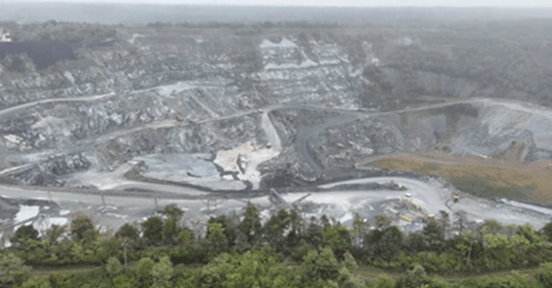
Over the years, the future of the deep Rockville Quarry on Travilah Road has been envisioned in numerous ways. In the 1980’s it was proposed to become a giant trash dump inciting strong opposition – that idea was abandoned. Parks once considered it for a recreational amenity. Some interest has been shown for siting solar arrays. However, a new study from the Interstate Commission on the Potomac River Basin (ICPRB) warns the capital region is uniquely vulnerable to catastrophic economic consequences from a disruption in the drinking water supply from the Potomac River – the sole source of water for 5 million people. The analysis predicted the region would suffer a $15 billion economic impact in the first month should the water supply from the Potomac River be cut off by drought or other environmental disaster such as an oil spill. The quarry conversion study comes as water planners and economists remain deeply worried about climate trends leading to historic droughts, or environmental disasters crippling the system. WMCCA will follow this issue closely.
Here is a link to a video about this project from WUSA: https://www.wusa9.com/article/tech/science/environment/rockville-maryland-quarry-eyed-as-future-reservoir-dc-water-supply-drinking-potomac-river/65-51510dc0-83f8-4216-a718-3441284d2757
REMINDER: IT’S TIME TO RENEW YOUR MEMBERSHIP FOR 2024-2025!
Please renew or become a new member of WMCCA. Go to our website www.wmcca.org to download a membership form or join using PayPal: Individual: $25 / Family: $50. We encourage donations to our Legal Fund. While we strive for positive results without litigation, sometimes it is unavoidable and highly effective. Contributions from members enabled us to join efforts to successfully address several issues as they affect the Potomac Subregion Master Plan, zoning, and environmental threats to the “Green Wedge”, our creeks and water supplies, and the Agricultural Reserve. If you have any issues or concerns in your neighborhood, please contact WMCCA. We appreciate the input from our neighbors. Our Membership year runs from October 1st to September 30th. Thank you for your support !!
Let us know if you are willing to go paperless. E-Newlettters save the expense of rising postage and printing costs. Thank you!! Please email: hooverb@msn.com .
Mark Your Calendars for October 19, 2024 – POTOMAC DAY!
Visit our WMCCA Booth #21 and enjoy a treat from the Ag Reserve!
West Montgomery County Citizens Association Newsletter
P.O. Box 59335, Potomac, MD 20854-9335
President – Ginny Barnes: President@WMCCA.org
Website: WMCCA.org – Thomas Fahey, Newsletter Editor – Nancy Madden
 West Montgomery County Citizens Association